


Early Mathematics (Birth to 4)
Building early number, shape and pattern through play and everyday experiences.
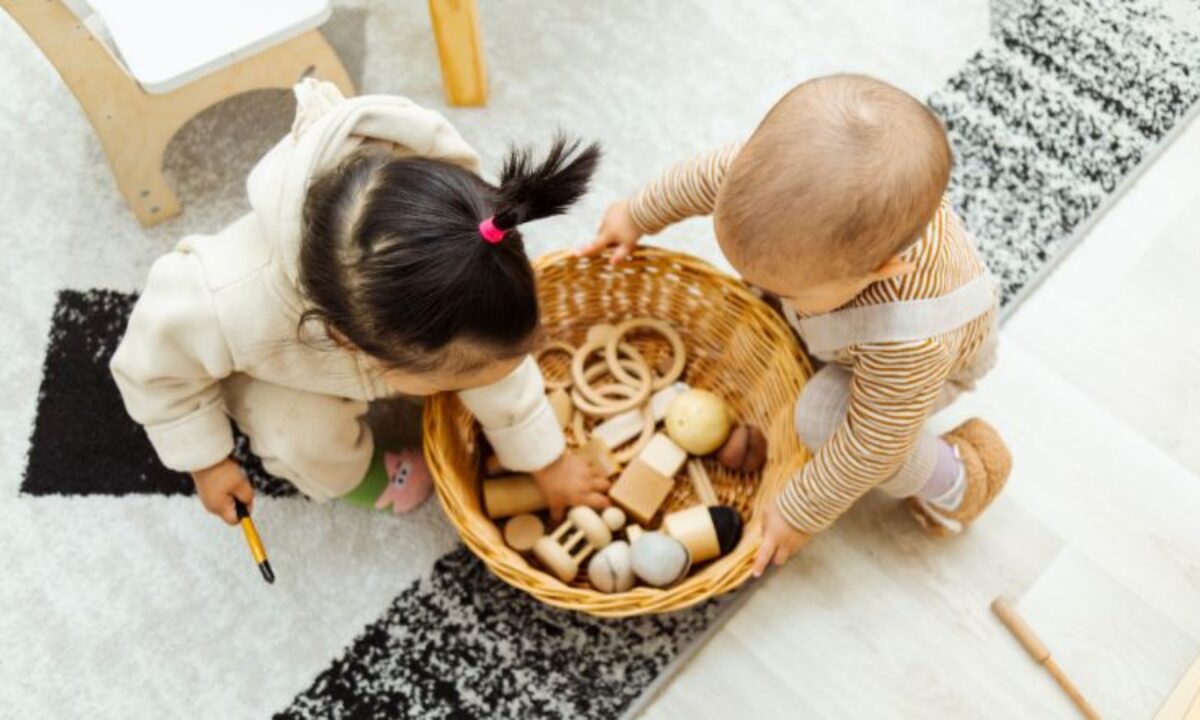
At our federation, early mathematics is rooted in the EYFS statutory framework and Development Matters guidance. We understand that babies, toddlers and young children learn mathematics best through hands-on exploration, talk, repetition and meaningful everyday experiences.
From birth, children are naturally mathematical. They explore size, shape, quantity and pattern as they play. Our role is to notice, support and extend this learning, ensuring every child builds secure foundations for later success.
We focus on helping children:
-
explore objects and materials freely
-
notice changes in amount and position
-
develop early counting behaviours
-
use mathematical language in context
-
recognise patterns and relationships
-
build early spatial awareness
Adults sensitively join children’s play, modelling language and drawing attention to mathematical ideas as they arise.
Children are supported to:
-
put objects in and take them out
-
stack, nest and line up cups and blocks
-
complete inset puzzles
-
climb, tunnel and hide
-
compare size, weight and capacity
-
notice simple patterns
Adults provide rich experiences using everyday objects such as spoons, boxes, balls and containers, while modelling spatial and comparative language like:
up, down, under, on top, bigger, smaller, heavy, light.
Finger rhymes, number songs and routines such as changing and mealtimes are used to introduce early counting, noticing “more”, “same” and “lots”, and reacting to changes in small groups of objects.
Three and Four Year Olds: Developing Early Number and Pattern
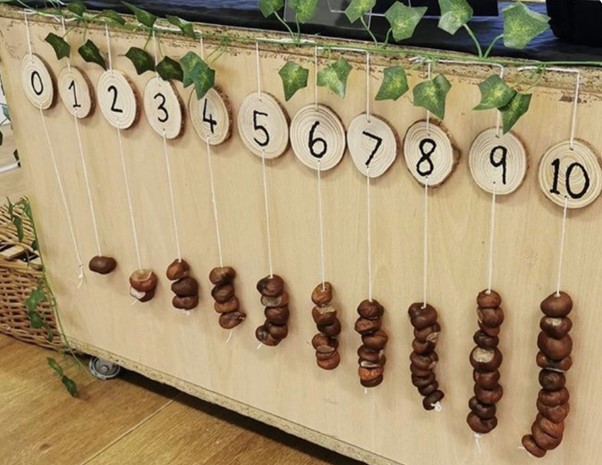
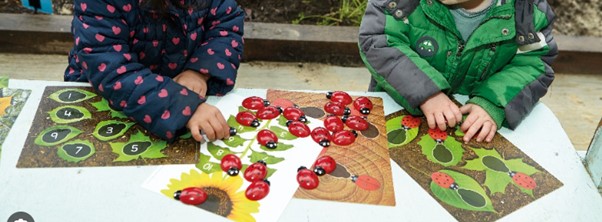
As children grow, they begin to:
-
recognise small quantities without counting (subitising)
-
recite numbers beyond 5
-
count with one number for each object
-
understand that the last number tells how many there are
-
show finger numbers to 5
-
link numerals to quantities
-
compare amounts using more and fewer
Children solve real-life problems such as sharing resources, finding enough chairs, or counting snacks.
They explore:
-
2D and 3D shapes
-
position and direction
-
size, length, weight and capacity
-
repeating patterns
-
simple sequences of events
Adults encourage children to talk about what they notice, explain their thinking, and use their own marks, drawings and symbols to represent ideas.
Patterns are explored through natural materials, movement, music and stories, helping children develop early reasoning and prediction skills.
Talk for Mathematics
Language is central to mathematical development.
Adults:
-
model mathematical vocabulary
-
ask open-ended questions
-
encourage children to explain their ideas
-
support problem solving using fingers, objects and marks
Children are given many opportunities to talk during play, routines and adult-led learning, building confidence to share ideas and reason with others.
Learning Through Play and Real Life
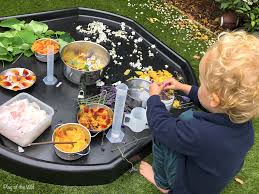
Mathematics is woven throughout the day.
Children explore maths through:
-
construction and den building
-
water and sand play
-
cooking and snack routines
-
outdoor obstacle courses
-
stories, songs and imaginative play
Resources are accessible indoors and outdoors, encouraging independence and exploration. Adults ensure play is purposeful by extending thinking and introducing new concepts where appropriate.